Applications

Wastewater Treatment Plant

Wastewater treatment plants face increasing pressure to comply with stringent discharge standards while optimizing operational efficiency. Our intelligent water quality monitoring solutions deliver reliable, real-time data across the entire treatment process — from influent to effluent — enabling plant operators to respond instantly to water quality variations, reduce energy consumption, and maintain full regulatory compliance even under the toughest conditions.

Municipal sewage treatment plant
【Does your WWTP face】

Fluctuating influent disrupting stable operations?

Tightening discharge compliance thresholds?

Energy-cost squeeze with rising efficiency demands?

【Key monitoring requirements include】
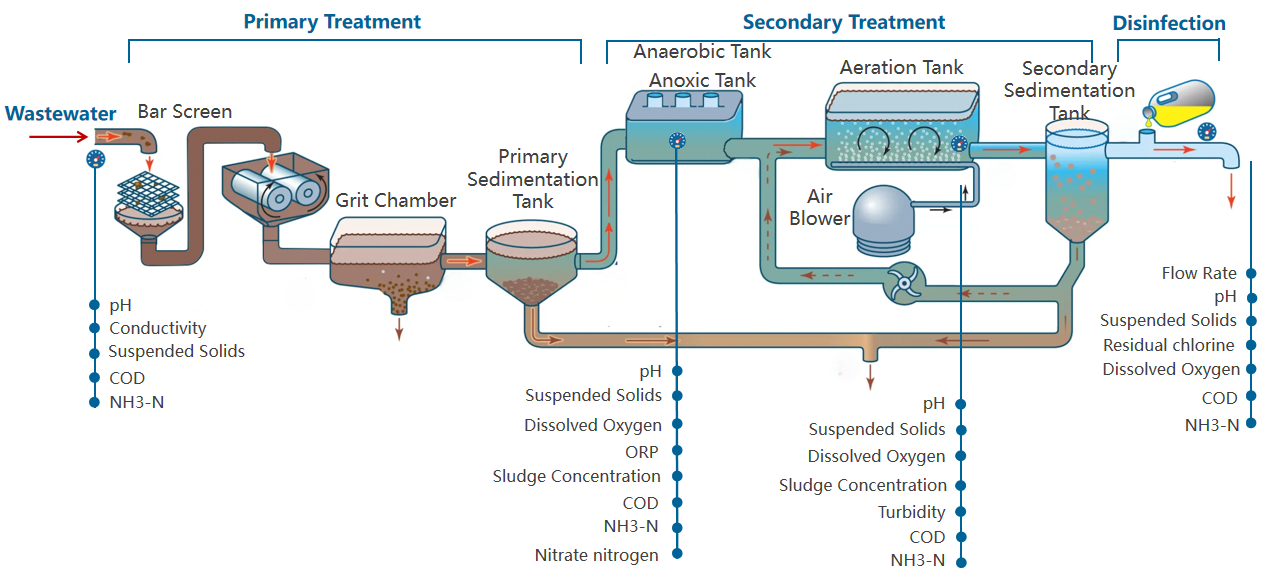
  • Influent monitoring — Assessing raw wastewater characteristics, providing baseline data for process control

  • Biological tank monitoring — Tracking DO, NH₄⁺-N, NO₃⁻-N, pH to optimize aeration and nitrification/denitrification processes

  • Secondary sedimentation — Monitoring sludge blanket level and effluent quality

  • Effluent monitoring — Ensuring compliance with discharge permits and receiving water quality standards

【Our Solution】

Linksens provides a comprehensive, end-to-end water quality monitoring solution tailored specifically for wastewater treatment plants. Our intelligent sensor network spans the entire treatment train — from raw influent to final discharge — delivering continuous, real-time data that empowers plant operators to optimize processes, reduce operational costs, and maintain regulatory compliance.

app-9


Monitoring points Purpose
Influent inlet Real-time monitoring & anomaly alerting
Anaerobic Reactor Process parameter optimization via dynamic tuning
Aeration Basin Automated chemical dosing adjustment (analytics-driven)
Final Effluent Launder Predictive discharge compliance risk forecasting with preemptive alerts


【Inlet Monitoring】

ParametersCOD, Ammonia Nitrogen (NH₄⁺-N), pH, Temperature, Flow Rate

Recommended Products

  • S-MT191 Multi-Parameter Water Quality Sensor

  • K-COD004 Online COD Analyzer

Why It Matters:

Raw influent characterization is the foundation of effective process control. Knowing incoming pollutant loads allows operators to anticipate aeration demands, chemical dosing requirements, and sludge production. Linksens S-MT191 multi-parameter sensor simultaneously monitors up to 9 parameters including COD, NH₄⁺-N, pH, and temperature via a single IP68-rated probe with RS-485 Modbus RTU output. The K-COD004 digital COD analyzer provides rapid, laboratory-grade COD measurements for more detailed analysis when needed


【Biological Treatment Tank】

Parameters : Dissolved Oxygen (DO), Ammonia Nitrogen (NH₄⁺-N), Nitrate Nitrogen (NO₃⁻-N), pH, ORP

Recommended Products :

  • S-DO011 DO Sensor (membrane-free, maintenance-free optical technology)

  • NH₄⁺/NO₃⁻/TN 4-in-1 Digital Sensor

Why It Matters : The biological tank is the heart of the wastewater treatment process. This is where microorganisms break down organic matter and remove nitrogen through nitrification and denitrification — two processes that demand precise control. DO directly determines the efficiency of aerobic degradation: too little DO starves the microbes; too much wastes energy (aeration can account for 50-70% of a plant's total electricity consumption). NH₄⁺-N monitoring enables ammonium-based aeration control, a proven energy-saving strategy, while NO₃⁻-N ensures denitrification is proceeding properly for total nitrogen removal. Linksens' optical DO sensor uses advanced fluorescence technology, requires no membranes or calibration solutions, and delivers stable, drift-free measurements even in sludge-laden environments. The four-in-one NH₄⁺/pH/NO₃⁻/TN digital sensor features built-in isolation for noise rejection in electrically noisy environments

【Secondary Sedimentation Tank】

Parameters : Sludge Blanket Level, Turbidity, Suspended Solids (SS/TSS)

Recommended Products :

  • S-MT191 Multi-Parameter Probe (turbidity & TSS measurement capability)

  • Dedicated sludge blanket sensor (custom configuration)

Why It Matters : The secondary clarifier separates biological solids from treated water. Monitoring sludge blanket level prevents solids carryover into the effluent while optimizing sludge wasting schedules. Turbidity and TSS provide real-time feedback on solid-liquid separation efficiency, allowing operators to detect upset conditions early — from rising sludge (caused by denitrification in the clarifier) to bulking sludge (caused by filamentous bacteria overgrowth). By integrating these measurements, plants can maintain effluent clarity and protect downstream filtration or disinfection processes.

【Disinfection and Final Effluent】

Parameters : COD, NH₄⁺-N, TN, TP, Turbidity, pH, Residual Chlorine

Recommended Products:

  • S-MT191 Multi-Parameter Water Quality Sensor

  • K-COD004 Online COD Fast Analyzer

  • Dedicated TN/TP sensors (custom configuration)

Linksens sensors deliver the continuous, real-time data needed to demonstrate discharge permit compliance and enable rapid corrective action when water quality deviates from permitted limits — a critical requirement under the new GB 18918-2002 Amendment.

【Why Choose Linksens for Wastewater Monitoring】
  • Full-coverage solution, one-stop shop — From influent to effluent, we provide sensors, controllers, and data integration—everything needed to build a complete plant monitoring network

  • Built for the harshest environments — IP68-rated, corrosion-resistant housings and anti-fouling sensor designs engineered for reliable life in sludge, chemicals, and humidity

  • Low maintenance, high up-time — Reagent-free optical and ISE technologies eliminate frequent calibration and consumable replacement

  • Seamless integration — Standard Modbus RTU/RS-485 protocols ensure easy connection to existing SCADA, PLC, or cloud-based monitoring systems

  • Global support — Serving governments, industries, and innovators worldwide, with responsive technical support and application expertise

【FAQ】
  1. How often do Linksens sensors require calibration and maintenance?

    Linksens optical DO sensors and ISE-based ammonia/nitrate sensors are reagent‑free and membrane‑free. Under normal wastewater conditions, calibration is recommended every 6–12 months. Routine maintenance (sensor cleaning) typically takes less than 10 minutes per month, greatly reducing operator workload compared to traditional electrochemical sensors.

  2. Can Linksens sensors integrate with existing SCADA or PLC systems at our plant?

    Yes. All Linksens sensors feature standard RS‑485 output with Modbus RTU protocol. They can be directly connected to most SCADA systems, PLCs (Siemens, Allen‑Bradley, Mitsubishi, etc.), and third‑party data loggers without proprietary gateways. We also provide technical documentation and sample code to support seamless integration.
  3. How do Linksens sensors perform in harsh conditions like high sludge or extreme temperatures?

    Our sensors are engineered for the toughest wastewater environments. The S‑MT191 multi‑parameter probe is IP68‑rated and fully submersible, with anti‑fouling materials that resist biological slime and chemical corrosion. The optical DO sensor operates reliably from 0–50°C with automatic temperature compensation. For extreme industrial wastewater (high salinity, high temperature, or aggressive chemicals), we offer customized housing options (titanium alloy, Hastelloy) to meet specific requirements.

Product recommendations

Have Questions About This Industry? We Have Answers!

Contact us for tech support, service, sales, or to get a quote.

Related articles

×

Please leave message to get a quotation and solution

VerifyCode *
*reguired fields