
Applications

Aquaculture

Water quality is the single most controllable factor determining the health, growth rate, and survival of farmed fish, shrimp, and other aquatic species. A dissolved oxygen crash lasting just a few hours can devastate an entire pond stocking. Ammonia accumulation from uneaten feed and metabolic waste suppresses growth and increases disease susceptibility. pH swings stress fish and destabilize the biological environment.


Linksens aquaculture monitoring sensors provide continuous, real-time water quality data for pond aquaculture, recirculating aquaculture systems (RAS), cage aquaculture, and hatchery operations — enabling operators to detect and respond before problems become losses.
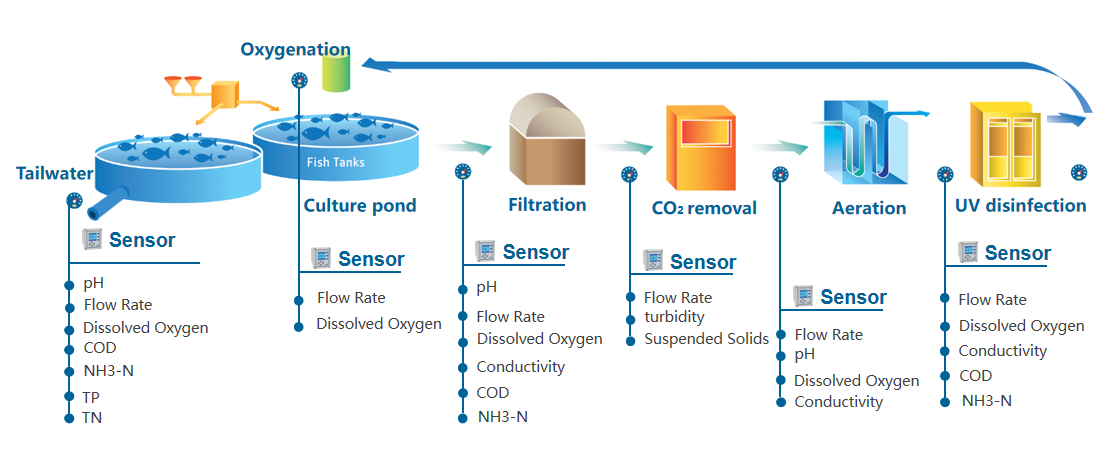

Application in Aquaculture Scenarios
【Aquaculture Water Quality Monitoring Challenges】

• Dissolved oxygen levels fluctuate dramatically with algae photosynthesis cycles — minimum DO typically occurs pre-dawn when animals are most vulnerable

• Ammonia toxicity increases sharply with rising pH and temperature — all three parameters must be monitored together

• In RAS systems, biofilter performance must be tracked continuously to prevent ammonia and nitrite accumulation

• Remote pond sites may have limited grid power — sensors must operate reliably on solar or battery power

• Saltwater and brackish aquaculture environments are corrosive to standard sensor materials


【Critical Water Quality Parameters for Aquaculture】
  • Hatchery:Temperature stability, dissolved oxygen (DO), ammonia control for larval survival

  • Grow-out ponds/RAS systems :Continuous DO, pH, temperature, ammonia, nitrite monitoring for growth optimization

  • Feeding management: Real-time DO response to adjust feeding rates, preventing feed waste

  • Effluent discharge: COD, ammonia, total phosphorus, suspended solids monitoring for regulatory compliance


Parameter

Target Range

Why It Matters

Dissolved Oxygen (DO)

>= 5 mg/L (fish); >= 4 mg/L (shrimp)

Prevents suffocation; directly drives feeding activity and growth rates

pH

6.5 – 8.5 (freshwater); 7.8 – 8.3 (marine)

Affects gill function, enzyme activity, and free ammonia toxicity

Ammonia Nitrogen (NH4+)

< 0.5 mg/L total ammonia

Chronic sub-lethal toxicity suppresses immunity and growth performance

Temperature

Species-specific optimal range

Controls metabolic rate, DO solubility, and disease susceptibility

Conductivity / Salinity

Species-specific tolerance range

Osmotic stress control; species-specific salinity requirements

Turbidity

< 30 NTU (general guideline)

Indicates algae density, feed consumption status, and sediment load

ORP

> +200 mV

Overall pond health indicator; pathogen suppression index


【The Linksens Solution】

Linksens provides a comprehensive range of water quality sensors and monitoring systems specifically engineered for demanding aquaculture environments—from hatchery tanks to grow-out ponds to recirculating aquaculture systems (RAS).

Our instruments deliver continuous, accurate data that enables farmers to:

  • Reduce mortality — Immediate alerts when parameters move outside safe zones

  • Lower feed costs — Optimize feeding based on real-time DO and activity levels

  • Improve FCR — Maintain ideal dissolved oxygen for maximum feed conversion efficiency

  • Meet regulations — Document effluent quality and ensure compliance

  • Operate remotely — Monitor multiple ponds or tanks from a single dashboard


水产养殖

Recommended Linksens Products

Product Model

Measured Parameters

Best For

S-DO011 Dissolved Oxygen Sensor

DO, Temperature

Pond overnight DO monitoring and aeration control automation

S-NH131 Ammonia Nitrogen Sensor

NH4+, Temperature

RAS biofilter performance and pond NH4+ tracking

S-pH001 / S-pH002 pH Sensor

pH, Temperature

Continuous pond or RAS tank pH monitoring

S-EC022 Conductivity Sensor

EC, Salinity, TDS

Brackish and marine aquaculture salinity management

S-ORP042 ORP Sensor

ORP, Temperature

Pond health assessment and disinfection monitoring

Multiparameter Water Quality Sonde

pH, DO, EC, Turbidity, Temp

All-in-one buoy-mounted pond monitoring platform


【Key Parameters We Monitor】
Parameter Why It Matters
Dissolved Oxygen (DO) The most critical parameter. Low DO stops feeding, increases FCR, and kills stock rapidly.
Ammonia (NH₄⁺) Toxic even at low concentrations; accumulates quickly in high-density systems.
Nitrite (NO₂⁻) Damages gill function and reduces oxygen uptake in blood.
pH Affects toxicity of ammonia and availability of nutrients; drastic shifts stress fish.
Temperature Directly controls metabolic rate, feeding activity, and disease risk.
【Applications】

Grow-Out Ponds

Continuous monitoring of DO, pH, temperature, and ammonia helps optimize aeration schedules, adjust feeding rates, and prevent health issues before they impact production.

Recirculating Aquaculture Systems (RAS)

In closed-loop RAS systems where water is continuously recycled, monitoring is especially critical. Linksens sensors provide the real-time data needed to maintain biofilter performance, control organic loads via COD measurement, and avoid toxic ammonia build-up.

Hatcheries & Nurseries

Larval and juvenile stages are highly sensitive to water quality changes. Continuous monitoring of temperature, DO, pH, and ammonia ensures stable conditions that maximize survival rates and healthy development.

Effluent Discharge

Meeting tightening local and national discharge standards is a legal requirement for aquaculture operations. Linksens monitoring solutions help farms document COD, ammonia, TSS, and pH levels, providing reliable data for regulatory compliance.

【Why Choose Linksens for Aquaculture】
  • Tailored for aquaculture:Our sensors are specifically designed for the challenging conditions of fish and shrimp farming, including biofouling, electrical noise, and continuous submersion.

  • Low maintenance, high uptime:Optical and ISE technologies eliminate frequent calibration, membrane replacement, and consumable costs.

  • One-stop solution:From single sensors to complete multi-parameter monitoring systems, we provide everything needed for effective aquaculture water quality management.

  • Seamless integration:Standard RS-485 output with Modbus RTU protocol connects directly to SCADA, PLC, IoT systems, or cloud platforms.

  • Built to last:IP68-rated, corrosion-resistant materials, and robust electronics ensure reliable operation in harsh environments.

  • Global support:Backed by responsive technical support and application expertise for customers worldwide.

Click here to download the water quality monitoring solution for aquaculture:

https://www.linksens-hk.com/upload/files/article/20260612/79d0f4d26bba4836a8fb145960a0e1a2.pdf

Frequently Asked Questions
【FAQ】

Q: What dissolved oxygen level is critical for shrimp versus fish?

A: Most commercial fish species (tilapia, salmon, sea bass) require a minimum of 5 mg/L DO, with optimal growth above 7 mg/L. Pacific white shrimp (Litopenaeus vannamei) show stress below 4 mg/L, with mass mortality risk below 2 mg/L. Because DO drops fastest in pre-dawn hours due to respiration without photosynthesis, continuous overnight monitoring is essential.


Q: How does the S-DO011 optical sensor compare to membrane-type DO sensors in pond environments?

A: The S-DO011 uses optical fluorescence technology, which eliminates the membrane fouling and electrolyte replacement issues common with Clark-cell (polarographic) DO sensors. In aquaculture ponds with high biological activity and algae, optical DO sensors require significantly less maintenance and deliver more stable long-term readings without the need for membrane replacement.


Q: Can sensors operate on solar power for remote pond sites?

A: Linksens sensors operate on 9–30V DC, making them fully compatible with 12V or 24V solar power systems. The low power consumption (typically under 1W per sensor) means a modest solar panel and battery bank can power multiple sensors continuously, even through several consecutive cloudy days.

Product recommendations

Have Questions About This Industry? We Have Answers!

Contact us for tech support, service, sales, or to get a quote.

×

Please leave message to get a quotation and solution

VerifyCode *
*reguired fields