


Full-Spectrum AI Real-time Water Quality Monitor



The online dissolved oxygen sensor uses fluorescence technology to measure dissolved oxygen in water. It features a built-in temperature sensor for automatic temperature compensation and supports manual compensation for air pressure and salinity. The sensor communicates via RS485 interface with standard Modbus protocol.
● Integrated design, resistant to electromagnetic interference;
● Industrial online oxygen sensing electrode, capable of stable operation for extended periods
●Built-in temperature sensor for real-time temperature compensation;
● Supports salinity and pressure compensation;
●Stainless steel casing, IP68 waterproof rating, suitable for various working conditions;
●RS485 signal output, standard Modbus protocol, easy to integrate and network.
●Wastewater and industrial wastewater treatment processes and discharge point water quality monitoring;
●Monitoring of drinking water intake and treated water quality;
●Surface water and groundwater monitoring.
Mode |
S-DO011 |
Parameter |
Technical Specification |
Working Principle |
fluorescence method |
Measuring Range |
Dissolved Oxygen: (0–20) mg/L or (0–200)%; Temperature: (0–60)℃(customizable ranges available) |
Resolution |
0.01mg/L |
Accuracy |
±0.3mg/L |
Repeatability |
±0.3mg/L |
Response Time |
<60s |
Protection Rating |
IP68 |
Zero/Range Drift |
±0.3mg/L |
| Temperature Compensation Accuracy | ±0.3mg/L |
| Calibration Cycle | 3 months |
| Power Supply Voltage | (12/24) V DC |
| Power Consumption | <0.5W |
communication interface |
RS485 (Modbus RTU), maximum baud rate 115200 bps |
Temperature Range |
(0 ~ 60)℃ |
Weight/ Dimensions |
0.5kg / 144mm × φ28mm |
| Material | Stainless steel, POM |
1. Unpacking Upon opening the packaging, carefully inspect the instrument for any damage that may have occurred during transport. If any damage is found, record it and report the loss to the carrier, our agent, or our customer service department.
2.2 Sensor Installation
The sensor has an NPT3/4 threaded interface at the tail, making it suitable for a variety of applications, such as pipes, pools, rivers, and lakes.
Note: When installing the sensor in the designated location, be sure to remove the protective cover on the dissolved oxygen membrane cap; otherwise, the sensor will not be able to measure properly.
01. Pipeline Installation
There are two ways to install pipes: 45-degree installation and 90-degree installation, as shown in Figures 2-1 and 2-2 .
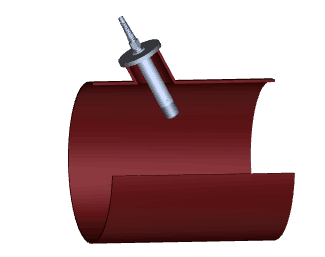
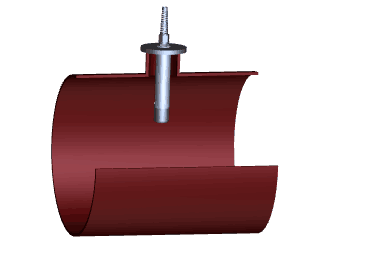
Figure 2-5 45-degree pipe installation; Figure 2-6 90-degree pipe installation
To ensure more accurate and stable measurements, the following conditions should be met when installing sensors in pipelines:
The sensor can be fixed by thread at the tail end or by clamping it with a flange;
Please install the electrode sensor inside a pipe with a diameter of 30 cm or more;
When installing in a pipeline, please install the sensor in an upward-flowing pipeline, not in a downward-flowing pipeline;
When the sensor is installed in a horizontal pipe, ensure that the first 100mm of the sensor tip is completely submerged in water;
Install the sensor at least 1.5 meters downstream of the pump, valve, or pipe bend, or at a distance three times the pipe diameter.
02. Installation of open channels and water tanks
When installing open channels or water tanks, a support frame is required to fix it to the tank wall, as shown in Figure 2-3 . The support frame needs to be designed according to the specific site conditions
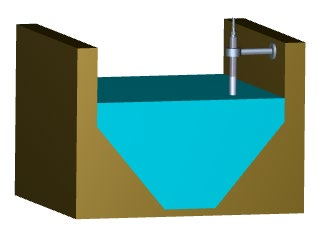
Figure 2-3 Installation of open channels and water tanks
To ensure more accurate and stable measurements, the following conditions should be met when installing sensors in rivers, open channels, and other similar locations:
The bottom of the sensor should be at least 10cm away from the bottom to reduce the impact of any sediment buildup on the measurement.
When installing the sensor, ensure the electrodes face the direction of the water flow (downstream) to reduce the risk of collision;
If there are large objects such as leaves in the water, a protective net should be added around the sensor.
03. Water Tank Installation
When installing the water tank, a fixing bracket is required to secure it to the tank cover, as shown in Figure 2-4 . The bracket needs to be designed according to the specific site conditions, and the opening in the water tank must ensure that the sensor can pass through the fixing hole.
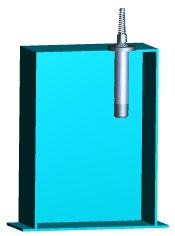
Figure 2-4 Water tank installation
To ensure more accurate and stable measurements, the following conditions should be met when installing sensors in the water tank:
The bottom of the sensor should be at least 10cm away from the bottom to reduce the impact of any sediment buildup on the measurement.














