

If you manage an aeration basin, a fish pond, or a drinking water treatment line, dissolved oxygen (DO) is probably one of the few numbers you check every single day. It's also one of the parameters most likely to drive real operating costs — aeration blowers in wastewater treatment can account for over half of a plant's total electricity bill, and DO control is usually how that cost gets managed.
Despite how central DO monitoring is, sensor selection is often treated as an afterthought. This guide covers what actually matters when choosing a dissolved oxygen sensor — measurement technology, maintenance burden, calibration practices, and integration — using the LinkSens S-DO011 optical DO sensor as a concrete reference point where relevant.
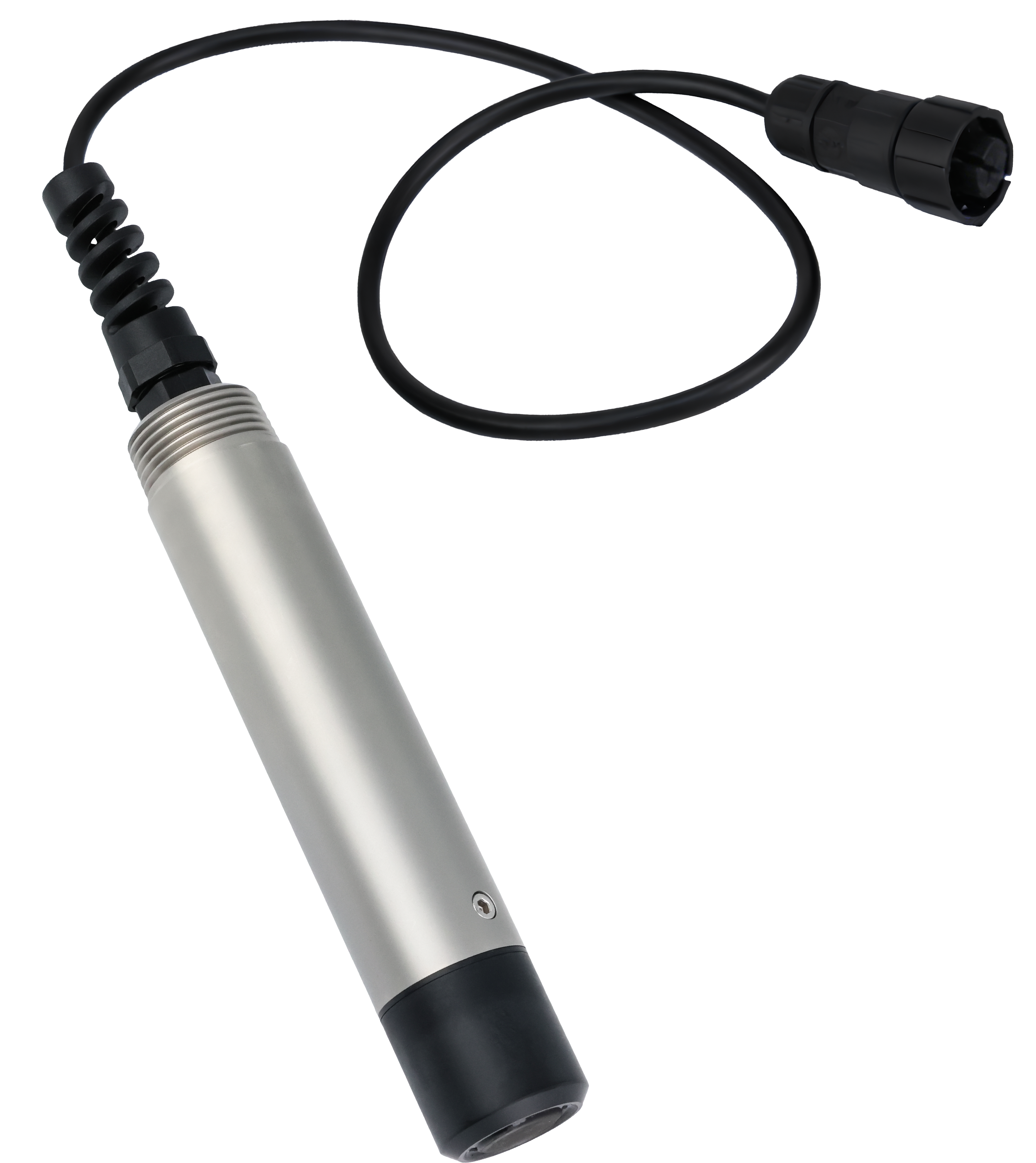
Unlike pH or conductivity, dissolved oxygen isn't a static chemical property of the water — it's constantly being consumed (by microorganisms, fish, oxidizing reactions) and replenished (by aeration, photosynthesis, surface exchange with the atmosphere). That means DO readings are inherently dynamic, and a sensor with slow response time or measurement drift can genuinely cause a control loop to over- or under-aerate, wasting energy or stressing aquatic life.
This is also why DO sensor technology has shifted significantly over the past two decades, from older electrochemical (Clark-cell, galvanic) methods toward fluorescence-based optical sensing — which addresses several of the older method's core weaknesses.
These measure DO via a chemical reaction at an electrode, consuming oxygen as part of the measurement process. They're well-established and historically lower-cost, but come with real operational drawbacks:
The membrane and internal electrolyte degrade over time and require regular replacement
Performance is sensitive to flow velocity past the membrane — some designs need a minimum flow rate to read accurately
Output tends to drift between calibrations, requiring more frequent recalibration
These work by exciting a fluorescent coating with light and measuring how oxygen molecules quench (reduce) that fluorescence — the more oxygen present, the more the fluorescent signal is quenched. The S-DO011 uses this fluorescence method, and the approach has a few practical advantages:
No oxygen is consumed during measurement, so there's no membrane to foul or replace on a fixed schedule
Much less sensitive to sample flow velocity, which simplifies installation
Better long-term measurement stability between calibrations, since there's no electrolyte to deplete
For most new installations today — especially unattended or hard-to-access monitoring points — optical DO sensors have become the practical default, with electrochemical sensors mainly persisting in legacy installations or specific cost-sensitive applications.
Most industrial and environmental applications fall within 0–20 mg/L (many sensors also offer a 0–200% saturation output as an alternative reading), which covers everything from oxygen-depleted wastewater to oxygen-saturated surface water. Within that range, resolution matters more than headline accuracy for control applications — a sensor with 0.01 mg/L resolution lets your control system react to smaller changes than one with 0.1 mg/L steps, which matters when you're trying to hold a setpoint tightly (e.g., maintaining 2.0 mg/L in an aeration basin rather than swinging between 1.5 and 2.5).
DO sensor accuracy is commonly specified as a fixed absolute figure, such as ±0.3 mg/L. Unlike a percentage-based spec, a fixed mg/L tolerance behaves consistently across the range, but it's worth thinking through what that means at the low end: at a 1 mg/L reading, ±0.3 mg/L represents a 30% relative error, while at 15 mg/L it's only 2%. If your process operates mostly at low DO setpoints — common in anoxic/anaerobic zones for nutrient removal — a fixed absolute accuracy spec like this is actually easier to reason about than a blended percentage/absolute spec, since you know exactly what margin to expect regardless of where you're reading.
Oxygen solubility in water is temperature-dependent and, in saline or brackish water, salinity-dependent as well — the same DO sensor reading can correspond to different actual oxygen saturation levels depending on water temperature and salt content. A sensor with built-in automatic temperature compensation handles the most common variable automatically; for applications involving variable salinity (aquaculture in brackish ponds, coastal monitoring), check whether the sensor supports manual salinity and atmospheric pressure compensation as well, since these factors can shift readings by a meaningful margin if ignored.
Optical DO sensors still require periodic calibration, since the fluorescent coating gradually wears with use even though no oxygen is consumed during measurement. Calibration is typically performed with standard solutions rather than ambient air: a saturated-oxygen standard solution for the high point, and an oxygen-free solution (often prepared with sodium sulfite, Na₂SO₃) for the zero point on sensors that support two-point calibration. This wet-chemistry approach is more rigorous than a simple atmospheric check, since it directly brackets the sensor's actual operating range rather than relying on ambient air as a proxy. After replacing the membrane cap, the sensor typically needs a stabilization period (commonly around 30 minutes) before a calibration will read reliably.
Optical DO sensors are often marketed as low-maintenance compared to electrochemical designs, and that's fair — but the fluorescent membrane cap is still a wear item, not a permanent part. A typical service life is around 1 year under normal conditions, after which the cap should be replaced and the sensor recalibrated. Ask your supplier directly how the cap is replaced (is it a simple screw-on cap, or does it require sending the unit back for service?) and how much a replacement cap costs, since this is a genuine ongoing cost of ownership that's easy to overlook when comparing sticker prices.
If the sensor is part of a solar-powered or battery-backed remote monitoring station (common in aquaculture ponds, stormwater monitoring, or hydrology stations), power draw matters. A low power design (well under 1W continuous draw) makes a meaningful difference in battery sizing and solar panel requirements compared to older sensor designs that can draw several watts during measurement cycles.
Wastewater treatment (aeration basins):
This is the highest-value use case for DO sensors, since aeration is typically the single largest energy cost in a treatment plant. Reliable, drift-resistant readings directly translate to blower energy savings — even a 0.5 mg/L reduction in over-aeration, sustained across a basin, can produce a measurable drop in monthly power consumption.
Aquaculture:
DO crashes are one of the leading causes of fish kills in intensive aquaculture. Here, response time and reliability matter more than absolute precision — a sensor that fails silently or drifts undetected is a far bigger risk than one with slightly lower accuracy. IP68-rated, submersible designs with minimal maintenance requirements are particularly valuable since these sensors are often deployed in ponds with limited access for servicing.
Drinking water treatment:
DO is monitored both as a water quality indicator and, in some processes, as an input for corrosion control (low DO can increase certain metal corrosion risks in distribution systems). Stability and low maintenance are the priority here, since these are typically long-term, low-touch installations.
Surface water and environmental monitoring:
DO is a key indicator of aquatic ecosystem health — levels below roughly 4–5 mg/L begin to stress many fish species, and prolonged low-DO events ("dead zones") are a major environmental concern in nutrient-impacted water bodies. For unattended field stations, low power draw and long calibration intervals become as important as the measurement itself.
| Question | Why it matters |
|---|---|
| Optical or electrochemical? | Determines maintenance burden and long-term drift behavior |
| What's the accuracy at low DO levels specifically? | A fixed mg/L spec is easier to reason about near zero than a blended %/absolute spec |
| Does it support salinity/pressure compensation? | Critical for brackish water or high-altitude installations |
| What's the calibration procedure — standard solutions or another method? | Determines whether you need to keep calibration reagents on hand |
| How long does the membrane cap last, and what does a replacement cost? | Even optical sensors have a wear item — typically around 1 year of service life |
| What's the power draw? | Matters for solar/battery-powered remote stations |
| What communication protocol does it use? | RS485/Modbus RTU is the most broadly compatible with SCADA/PLC systems |
For reference, the S-DO011 specifies a 0–20 mg/L (or 0–200% saturation) range, ±0.3 mg/L accuracy and repeatability, ≤60s response time, IP68 protection, RS485 Modbus RTU output, under 0.5W power consumption, and a stainless steel/POM housing rated for use up to 60°C — a useful baseline when comparing other optical DO sensors in this class.
LinkSens designs industrial sensing equipment for water and process monitoring, including the S-DO011 optical dissolved oxygen sensor. For technical specifications or help selecting the right DO sensor for your application, contact our team.


