Applications

Drinking Water

Safe drinking water is non-negotiable. Utilities and water authorities worldwide face growing regulatory requirements, aging infrastructure, and increasing source water variability — all of which demand accurate, continuous monitoring from source to tap.


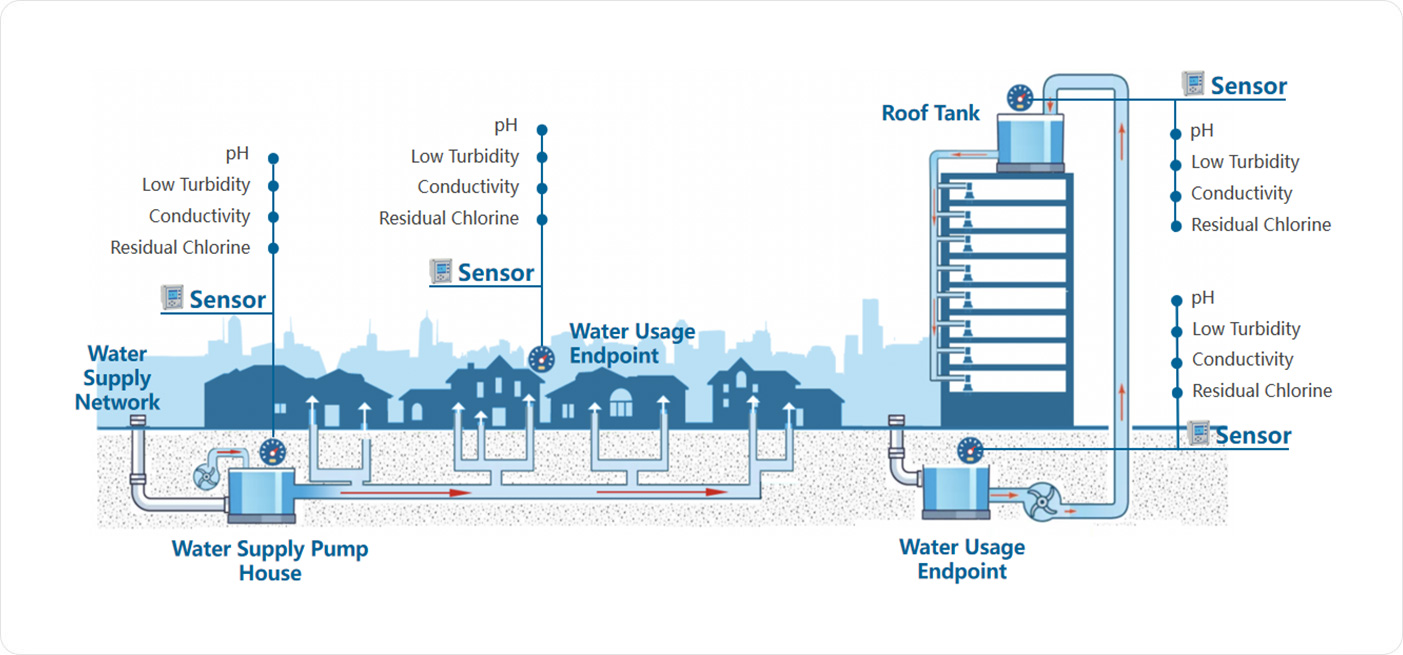
Linksens provides a complete range of online water quality sensors and analyzers for every critical control point in the drinking water supply chain: raw water intake, treatment plant processes, finished water storage, and distribution network endpoints.


Drinking Water Quality Monitoring
【Drinking Water Monitoring Challenges】

• Source water quality fluctuates seasonally — turbidity spikes, algal blooms, and contamination events require rapid detection

• Disinfection (chlorination) must be precisely controlled: too little risks pathogen breakthrough; too much produces harmful disinfection byproducts (DBPs)

• Distribution networks spanning hundreds of kilometers require distributed monitoring points with low-maintenance sensors

• WHO, EPA, and EU Drinking Water Directive limits are becoming more stringent, requiring verifiable continuous data


【Monitoring Parameters】

To guarantee water safety from source to tap, a comprehensive monitoring strategy must track the following key parameters. Linksens sensors are designed to measure each of them with high accuracy and stability:


Parameter Target Range
Why It Matters
Free Chlorine / Total Chlorine 0.2 – 1.0 mg/L (distribution) Disinfection efficacy and DBP formation control
pH 6.5 – 8.5 Controls corrosion, disinfection efficiency, and taste. Small deviations can indicate contamination.
Turbidity < 1 NTU (treated water) Filter performance indicator and pathogen surrogate
Dissolved Oxygen (DO) > 6 mg/L Indicates biological stability and potential for microbial regrowth in distribution networks.
Conductivity / TDS < 500 mg/L TDS (WHO) Flags dissolved salts, minerals, or potential intrusion of wastewater or brackish water.
Oxidation-Reduction Potential (ORP) > +200 mV Provides a real-time proxy for disinfectant activity and overall redox balance.
Temperature
Affects nearly all chemical and biological reactions, including chlorine decay and bacterial growth.
Ammonia Nitrogen (NH4+) < 0.5 mg/L Source contamination indicator; nitrification risk in distribution

Advanced monitoring may also include heavy metals (e.g., lead, copper) and turbidity combined with particle counts. Linksens modular platforms allow users to scale parameters based on their specific regulatory and risk profile.


1


【Our Solution: Linksens Smart Water Quality Monitoring】

Product Model Measured Parameters Best For
Digital Residual Chlorine Sensor Free Chlorine, Temperature

Chlorination dosing control and distribution monitoring

S-TUR033 Low-Turbidity Sensor Turbidity, Temperature Finished water and filter effluent (low NTU range)
S-pH001 / S-pH002 pH Sensor pH, Temperature Treatment plant and distribution network pH monitoring
S-EC022 Conductivity Sensor EC, TDS, Temperature Source water and process water quality tracking
S-DO011 Dissolved Oxygen Sensor DO, Temperature Reservoir and distribution system DO monitoring
S-NH131 Ammonia Nitrogen Sensor NH4+, Temperature Source water contamination detection


Linksens provides an integrated, digital-first solution that addresses the shortcomings of traditional monitoring. Our approach is built on three core pillars:

  1. Intelligent Digital Sensors
    Each Linksens sensor features an embedded data chip that stores calibration history, operating hours, and sensor-specific characteristics. This enables “plug-and-play” replacement—no on-site recalibration required. The chip automatically uploads parameters to the transmitter, reducing human error and saving hours of manual work.

  2. Unified LiquiCore Platform
    All Linksens transmitters, analyzers, and samplers run on our standardized LiquiCore platform. This means operators can mix and match different sensor types (pH, chlorine, turbidity, etc.) on a single transmitter, view all data on one screen, and leverage common spare parts. The platform supports Modbus, Profibus, and 4-20 mA outputs for seamless integration into existing SCADA systems.

  3. Real-Time Analytics & Predictive Alerts
    Data from Linksens sensors is continuously analyzed. The system learns normal parameter ranges for each specific plant and sends early warnings when drift or sudden changes occur. Operators receive mobile or desktop alerts, enabling predictive maintenance—for example, cleaning a sensor before its reading becomes invalid, rather than after.

  4. Remote Access & Digital Twin
    Through our secure cloud portal, authorized personnel can monitor water quality trends, generate compliance reports, and adjust control parameters from anywhere. A digital twin of the monitoring network visualizes sensor health, remaining lifetime, and upcoming calibration dates.

Example in action: A municipal plant using Linksens reduced unplanned downtime by 62% in six months, thanks to predictive alerts on sensor fouling before it affected chlorine dosing.


【Customer Value】

Switching to Linksens monitoring delivers tangible benefits across safety, cost, and compliance:

  • Enhanced Water Safety
    Continuous, high-accuracy measurements (e.g., ±0.01 pH, ±2% of reading for chlorine) ensure that any deviation is caught within seconds—not hours. This dramatically lowers the risk of delivering non-compliant or unsafe water.

  • Lower Operational Costs

    • Less time spent on manual calibration and troubleshooting.

    • Reduced inventory thanks to interchangeable sensors and spare parts.

    • Fewer emergency site visits through remote diagnostics.

  • Simplified Compliance
    Automated data logging and timestamped records make regulatory reporting effortless. Linksens helps meet WHO, EPA, and local drinking water standards with audit-ready documentation.

  • Predictive Maintenance
    Instead of reactive or fixed-interval maintenance, the system tells you exactly when a sensor needs cleaning or replacement. This extends sensor lifespan by up to 30% and prevents process interruptions.

  • Future-Proof Scalability
    Whether you operate a single well or a regional network, the same Linksens platform scales with you. Add new sensors, remote sites, or advanced analytics modules without ripping out existing hardware.

Frequently Asked Questions
【FAQ】

Q: What is the difference between free chlorine and total chlorine monitoring?

A: Free chlorine refers to hypochlorous acid and hypochlorite ions immediately available for disinfection. Total chlorine includes free chlorine plus combined chlorine (chloramines). For drinking water distribution networks, free chlorine residual is the primary compliance parameter. Linksens offers sensors for both measurement types.


Q: Can sensors be installed directly in the distribution pipe network?

A: Yes. Linksens sensors support both flow-through (in-line flow cell) and immersion installation. For pipe network monitoring points — such as booster stations and pressure zone boundaries — flow-through assemblies ensure a representative sample without stagnation effects.


Q: How do I protect sensors in outdoor distribution network monitoring cabinets?

A: All Linksens online sensors are rated IP68 for continuous immersion and fully protected against dust and water ingress. For outdoor installations, a ventilated enclosure cabinet is recommended to manage temperature extremes and UV exposure on cable connections.

Product recommendations

Have Questions About This Industry? We Have Answers!

Contact us for tech support, service, sales, or to get a quote.

×

Please leave message to get a quotation and solution

VerifyCode *
*reguired fields